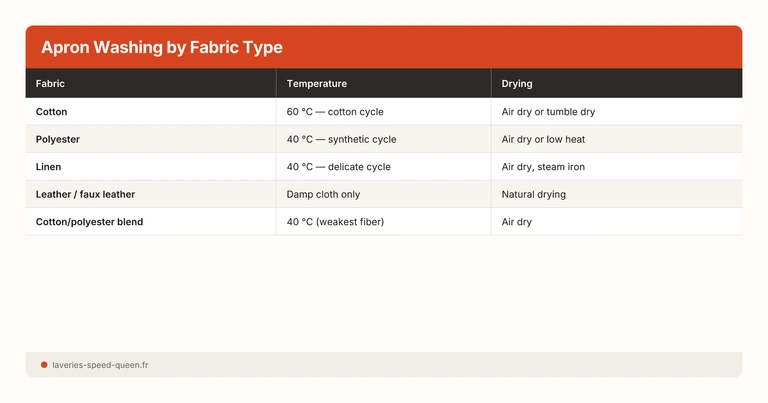
In short: a cotton kitchen apron washes at 60 °C (the temperature that kills foodborne bacteria), polyester at 40 °C, linen at 40 °C, and leather by wiping (no machine). Grease stains are pre-treated with dish soap, wine with white vinegar, tomato sauce with cold water + soap. Frequency: after every greasy use, or every 2-3 uses for light cooking.
At a glance
Cotton = 60 °C — cotton programme, the reference temperature for food hygiene.
Polyester = 40 °C — synthetic programme, no hotter or creases will set.
Leather = wipe only — damp cloth + mild soap, never water or machine.
Grease = dish soap — the best emulsifier for cooking fats.
Greasy cooking = wash after every use — meat, fish, frying: no second service.
Apron + tea towels = same machine at 60 °C — same environment, same temperature.
Why your kitchen apron deserves regular washing
The kitchen apron is a protective garment that absorbs everything the kitchen throws at it: grease splashes, sauce spatters, flour traces, raw meat residue. Unlike an ordinary garment that can be worn several times, the kitchen apron comes into direct contact with potentially contaminated food.
The hygiene issue
The most common foodborne bacteria (E. coli, Salmonella, Listeria, Staphylococcus aureus) spread by contact. An apron that wiped raw meat juice and is reused the next day without washing becomes a contamination vector: your hands touch the apron, then touch food.
A study published in the Journal of Applied Microbiology (2017) showed that kitchen textiles (tea towels, aprons) are underestimated cross-contamination vectors in domestic kitchens. Bacteria survive several hours on a damp fabric at room temperature.
The grease problem
Grease is the kitchen apron’s main enemy. Cooking fats (olive oil, butter, frying grease) penetrate deep into textile fibres and oxidise over time. An apron whose grease stains are not treated promptly develops a characteristic rancid smell and permanent brownish marks.
By material: the right programme
Cotton (the most common)
The classic choice, tough and hygienic. Cotton programme 60 °C, standard detergent, normal spin (1000-1200 RPM). Cotton tolerates repeated washing, percarbonate, and even bleach (if white). Monthly cycle at 90 °C for thorough disinfection.
Polyester / synthetic
Lightweight, quick-drying, crease-resistant. Synthetic programme 40 °C, liquid detergent. Polyester retains odours less than cotton but grease stains embed more easily. Always pre-treat grease stains with dish soap.
Linen
Elegant and naturally antibacterial. Delicate programme 40 °C, mild detergent. Linen dries quickly (an advantage in the kitchen) but creases heavily. Iron at 200-230 °C with steam. Avoid the tumble dryer, which stiffens it.
Leather / faux leather
BBQ or professional kitchen aprons. No machine, no immersion. Wipe with a damp cloth + mild soap (Marseille soap). Air-dry. Condition the leather with a colourless balm twice a year. Grease stains come off with make-up remover milk or leather cleaning milk.
Common stains: pre-treatment before the machine
Pre-treatment is the key to a clean apron. The washing machine alone does not always remove kitchen stains, especially if they have had time to dry.
Grease stains (oil, butter, frying)
Grease is the most frequent stain on a kitchen apron. Dish soap is the best pre-treatment because it contains surfactants specifically formulated to emulsify cooking fats.
- Apply a drop of neat dish soap directly to the stain
- Rub gently with your fingers to work the product in
- Leave for 15 minutes
- Rinse with hot water (heat liquefies the grease)
- Machine wash normally
For old, ingrained grease stains: sprinkle baking soda on the stain, leave to absorb for 30 minutes (baking soda absorbs surface grease), then apply dish soap. Detailed guide: remove a grease stain.
Red wine stains
Red wine contains anthocyanins, natural pigments that bind quickly to textile fibres.
- Act immediately — the longer you wait, the harder the stain will be to remove
- Rinse with cold water (hot water sets tannins)
- Apply neat white vinegar to the stain
- Leave for 10 minutes
- Dab with a clean cloth
- Machine wash
Detailed guide: remove a red wine stain.
Tomato sauce stains
Lycopene (the tomato’s red pigment) is a fat-soluble pigment that penetrates fibres easily, especially in the presence of grease.
- Rinse with cold water immediately
- Apply Marseille soap directly to the stain
- Rub gently and leave for 15 minutes
- Rinse and machine wash
Detailed guide: remove a tomato sauce stain.
Spice stains (turmeric, curry, saffron)
Yellow spices contain curcumin, an extremely stubborn pigment that resists most standard treatments.
- Rinse with cold water
- Expose the stain to sunlight — UV breaks down curcumin (the only effective natural method)
- If the stain persists, apply a sodium percarbonate paste (with a little water), leave for 1 hour
- Machine wash at 60 °C
Detailed guide: remove a curry/turmeric stain.
The golden rule: pre-treat before it dries
Every kitchen stain is easier to remove when fresh. A grease stain treated immediately with dish soap disappears in one wash. The same stain left 48 hours may need 2 or 3 successive treatments. If you cannot wash straight away, at least pre-treat the stain and leave the apron soaking in cold water.
Wash frequency: by type of use
Wash frequency depends on the intensity and type of cooking.
Greasy cooking (meat, fish, frying)
After every use. Raw meat, fish, and frying grease are significant sources of bacterial contamination. An apron that has been in contact with raw meat juice must not be reused without washing — even if it “looks clean”.
Light cooking (vegetables, baking, steaming)
Every 2-3 uses, or as soon as a visible stain appears. Plant-based cooking and baking produce less bacterial contamination, but flour, egg, and butter stains build up.
Serving / presentation apron
If the apron is worn to serve at the table (no contact with preparation), a weekly wash is enough, or as soon as it is stained.
The professional apron: regulated hygiene
In commercial catering, the kitchen apron is work clothing subject to food-safety regulations. The rules are strict:
- Wash after every service — mandatory
- White apron recommended — stains are visible immediately, forcing a change
- Wash temperature: 60 °C minimum — in line with hygiene guidelines
- Separate storage — the dirty apron must not contact the clean one
- Multiple aprons per station — a minimum of 5 aprons per cook to maintain rotation
- Never wear a kitchen apron in the dining room — the preparation apron is potentially contaminated. Change aprons between kitchen and service.
- Do not wash professional aprons at home at 40 °C — 60 °C minimum to meet food-hygiene standards.
- Replace a torn or frayed apron — damaged fibres harbour more bacteria and are harder to clean.
- An apron is not a tea towel — do not wipe your hands on the apron. Use a tea towel or paper towel.
The child’s apron: paint, glue, and food
Children’s aprons face every challenge at once: paint, glue, felt-tip, food, mud. Pre-treatment is even more important than for a standard kitchen apron.
Water-based paint (gouache, watercolour)
Gouache and watercolour wash out easily as long as they have not dried. Rinse immediately with cold water, then machine wash at 40 °C. If the paint has dried, soak the apron in warm water with Marseille soap↗ for 1 hour before washing.
Acrylic paint
Fresh acrylic rinses off with water. Dried acrylic is much more resistant — apply rubbing alcohol (isopropanol) to the stain, rub with a cloth, rinse. Machine wash. If the stain is very thick, scrape off the excess with a knife before the alcohol treatment. Guide: remove a paint stain.
Glue
White (PVA) glue dissolves in warm water while fresh. Dried glue softens in hot white vinegar↗ (soak 30 minutes). Superglue (cyanoacrylate) needs acetone — but check that the apron fabric tolerates acetone (test on a hidden corner). Guide: remove a glue stain.
Felt-tip and ink
Washable felt-tip comes out in a normal wash. Permanent marker needs rubbing alcohol applied directly to the stain. Guide: remove an ink stain.
Long-term care tips
Protecting prints and embroidery
If your apron carries a logo, print, or embroidery, turn it inside out before every wash. Drum friction wears down screen-printed designs. Avoid high-temperature tumble drying, which can crack heat-bonded prints.
Dealing with ties and straps
Cotton or polyester ties tangle in the drum and can snag other clothes. Tie them together before washing to prevent knots.
Starch for a spotless professional apron
White cotton professional aprons benefit from a spray starch after ironing. Starch gives the fabric a crisp, professional hold and creates a protective layer that makes stain removal easier at the next wash (grease adheres less to starched fibres).
Laundromat washing: ideal for professional batches
Caterers and chefs who need to wash a batch of aprons (5-15 after a service) find the large-capacity machines at the laundromat an efficient, fast solution. A 9 kg machine holds 8-10 cotton aprons, and the 60 °C programme ensures hygiene that meets food-safety standards.
Commercial tumble dryers dry a batch of cotton aprons in 30-40 minutes — versus 2 hours in a home dryer. A significant time saving for a professional.
Multiple aprons in rotation: the right approach
In the kitchen, one apron is not enough if you cook regularly. A grease- and sauce-stained apron worn for 3 consecutive days becomes a breeding ground for bacteria and develops stubborn odours that embed in the fibres.
The ideal is to own 3-4 aprons in rotation: one clean one in service, one or two in the laundry, and one in reserve. Change every 1-2 days of intensive cooking, or after every session involving raw meat or fish. Thick cotton aprons (canvas, twill) are the most resistant to repeated washing and high temperatures (60 °C without issue).
For professionals and passionate home cooks who accumulate large volumes of aprons, tea towels, and kitchen cloths, a weekly laundromat trip is often more practical than a home machine. The 9 kg machine easily handles a full week of kitchen textiles in a single 60 °C cycle.
As an Amazon Associate, we earn a small commission on purchases made through the affiliate links in this article — at no extra cost to you. This helps us maintain this site and produce free guides.
Our laundromats in Blagnac, Croix-Daurade and Montaudran offer large-capacity machines with 60 °C programmes and high-performance dryers. Ideal for washing a batch of aprons, tea towels, and kitchen linen in one go. Payment by contactless card or cash. See our prices.
Sources and references
- Washing temperatures guide
- Remove a grease stain
- Remove a red wine stain
- Remove a tomato sauce stain
- Washing linen guide
- How to disinfect laundry
- Whitening yellowed laundry
- Journal of Applied Microbiology (2017) — cross-contamination via kitchen textiles
- Food-safety regulations — work clothing hygiene in commercial catering