In short: a cold wash in practice means water around 20-30 °C. It suits the majority of lightly soiled everyday laundry, especially colours, synthetics and heat-sensitive textiles. For sheets, towels, tea towels or any need for enhanced hygiene, 60 °C remains the useful guideline if the care label allows it.
At a glance
20 to 30 °C -- the real range of a cold wash in practice.
Cold = everyday laundry -- colours, synthetics, sportswear, lightly soiled items.
60 °C = targeted hygiene -- sheets, towels, tea towels and specific cases.
Cold is not enough on its own -- you also need the right detergent, the right dose and the right drying.
What temperature is a “cold wash” exactly?
Short answer: in real life, a cold wash mainly plays out between 20 and 30 °C, but “cold” does not always mean the same thing on your machine. This is precisely the point of this article: not to redo a complete temperature guide, but to help you understand what your button or programme actually calls “cold”.
- the genuine
20 °Cregulated by the machine; - the
30 °Ceveryday low temperature; - the
coldbutton which, depending on the appliance, may simply use unheated tap water.
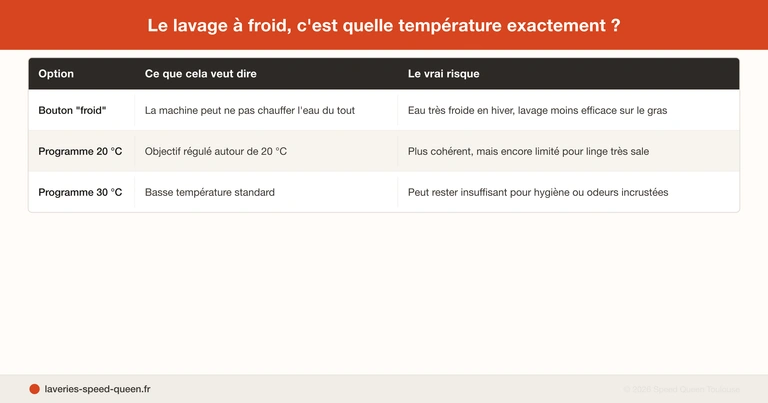
| Option | What it actually means | The real risk |
|---|---|---|
| ”Cold” button | The machine may not heat the water at all | Very cold water in winter, less effective on grease |
| 20 °C programme | Regulated target around 20 °C | More consistent, but still limited for heavily soiled items |
| 30 °C programme | Standard low temperature | May still be insufficient for hygiene or ingrained odours |
The point most guides miss
In winter, an unregulated “cold” programme can start with very cool water, sometimes as low as 8-15 °C depending on the property. That is not the same as a stabilised 20 °C cycle. Result: some detergents perform poorly on sebum, greasy marks or dried stains.
What does “cold wash” actually mean?
The term “cold wash” is vague because it does not correspond to a single temperature. Depending on the washing machine brand, the programme, the country and even the season, “cold” can mean very different things.
15-25 °C depending on the machine
In practice, a cold wash sits between 15 and 25 °C depending on the machine and chosen setting. Some recent models offer a regulated 20 °C programme: the heating element gently warms the mains water to a stable 20 °C. Others, when you select “cold”, simply do not heat at all: the water enters at mains temperature, which varies by season (8-12 °C in winter, 18-22 °C in summer in southern France).
The difference between “regulated cold” and “passive cold”
A regulated 20 °C programme guarantees a minimum temperature regardless of season. The classic “cold” button depends entirely on the mains water temperature. In January in Toulouse, mains water can enter at 10-12 °C. In August, at 20-22 °C. This 10 °C difference changes detergent effectiveness and the ability to dissolve greasy soiling.
What this means for your laundry
At 20-25 °C, most modern detergents work correctly on lightly soiled laundry. At 10-12 °C (unregulated winter cold), detergent struggles to dissolve fully (especially powder) and surfactants are less effective on body oils. This is why 30 °C is often the most reliable compromise for low-temperature washing.
Real effectiveness of cold washing
A persistent misconception holds that heat is essential to clean laundry. In reality, detergent does most of the work, not temperature. Studies show that the combination of mechanical action (drum agitation) + chemical action (detergent) + contact time accounts for the majority of wash effectiveness. Temperature is only one of the four factors in Sinner’s circle.
Detergent does the work, not heat
Modern detergents contain enzymes and surfactants formulated to act from 20 °C. These components break down proteins (blood, sebum), starches and light grease without needing heat. This is why the ADEME recommends lowering wash temperatures: on lightly soiled everyday laundry, the difference in results between 20 °C and 40 °C is often imperceptible.
Cold preserves fibres better
Every degree lower reduces stress on fibres. Colours stay brighter, synthetics deform less, elastane retains its stretch longer. This is also why technical sportswear and jeans benefit from low-temperature washing.
But cold does not disinfect
The limit of cold washing is clear: it does not disinfect. To kill dust mites, pathogenic bacteria or bed bugs, you need to go to 60 °C. Cold is sufficient for routine care of body-worn clothing and garments, but not for situations requiring enhanced hygiene.
When cold is NOT enough
Certain situations demand a higher temperature. Cold washing does not cover all needs.
Greasy stains and ingrained sebum
Body oils (sebum, sunscreen, cooking oils) dissolve better in heat. A shirt collar yellowed by sebum or a greasy kitchen towel will not be properly cleaned at 20 °C. For these cases, 40 °C is often the right compromise; 60 °C for very greasy cotton towels.
Disinfection needed
After a contagious illness (gastroenteritis, flu), laundry in contact with the sick person should be washed at 60 °C minimum if the care label allows. Cold removes visible soiling but does not guarantee elimination of pathogens. See our 60 °C guide to find out which textiles withstand this temperature.
Sheets, towels and household linen
Bedding and towels accumulate sebum, sweat, dead skin and moisture. Regular cold washing is not sufficient to maintain a satisfactory hygiene level on these textiles. 60 °C remains the recommended guideline for compatible cotton sheets and towels, at the right washing frequency.
Musty odours and biofilm
A garment that smells musty after slow drying, or towels that develop an odour despite washing, will not be sanitised by a cold cycle. The bacterial biofilm responsible for these odours resists low temperatures. A 60 °C cycle with well-dosed detergent is often needed to reset to a clean baseline. See our guide to laundry that smells bad.
When cold washing truly suffices
Lightly soiled everyday laundry
T-shirts, trousers, shirts, lightly worn underwear and slightly odorous textiles wash well at cold or 30 °C.
Colours and prints
Cold reduces the risk of colour bleeding, fading and premature wear on bright colours.
Synthetics and sportswear
Synthetic fibres cope poorly with excessive heat. Cold or warm limits deformation and protects elastane.
Energy savings
Heating water accounts for a large share of a washing machine's consumption. Lower temperatures therefore directly reduce energy costs.
20 °C, 30 °C or 40 °C: which to choose in practice?
The right question is not “cold or hot?” but “what is the lowest setting that does the job without overheating the textile?” This is where the article becomes useful: choosing just warm enough, no more.
| Setting | Choose it if… | Avoid it if… |
|---|---|---|
| 20 °C | The laundry is lightly soiled, coloured, synthetic or worn briefly | There is grease, sheets, towels or a truly stubborn odour |
| 30 °C | You want to stay at low temperature with a bit more cleaning margin | The textile requires enhanced hygiene or the care label demands higher |
| 40 °C | Coloured cotton is moderately soiled or sebum-laden | The garment is delicate, very colourful or heat-sensitive |
When cold is a bad idea
Cold is not bad in itself; it is simply insufficient in certain concrete cases. This is often where overly pro-cold content becomes misleading.
- Ingrained odours -- when the garment already smells strongly of mustiness, sweat or dampness.
- Heavily soiled laundry -- greasy stains, workwear, genuinely grimy garments.
- Enhanced hygiene needed -- sheets, towels, tea towels or heavily soiled baby laundry if the care label allows higher.
- Already grimy machine -- washing everything cold in a drum that smells bad does not fix the underlying problem.
In these cases, the right trade-off is not necessarily to jump straight to 60 °C. But stubbornly sticking to “cold” can give the impression the laundry comes out clean when the result is only partial.
Which detergent for cold washing?
At cold temperatures, detergent choice matters almost as much as the temperature. A well-dosed low-temperature formula compensates for the lack of heat better than a reflex “I’ll just go to 40”.
Liquid detergent
Often simpler at 20 °C because it disperses quickly and leaves fewer white traces on dark or synthetic laundry.
Poorly dissolved powder
At very low temperatures, an unsuitable powder can leave residue if the load is dense or the water is very cold.
Dosage remains decisive
Under-dosing loses effectiveness. Over-dosing clogs the machine and promotes bad odours: at cold, this mistake is quickly punished.
Realistic load
An overpacked cold wash cleans poorly. The right trio remains: low temperature, suitable detergent, a drum that actually agitates.
When you need to go above cold
Cold is not the universal answer. It preserves fibres well, but it is not the best choice when heat is part of the desired result.
When 60 °C remains the right guideline
Cold washing is not the ideal reflex for sheets, towels, tea towels, some heavily soiled baby items or textiles requiring enhanced hygiene. The ADEME recommends reserving hot cycles for uses that truly warrant them, while keeping the low-temperature programme as the default for everyday items.
You should mainly increase temperature if one of these criteria is present:
- laundry in prolonged contact with the body;
- white or heavily soiled textile;
- enhanced hygiene needed;
- care label allowing 60 °C;
- monthly machine maintenance cycle.
The downside of “everything cold”: when the machine gets clogged
Washing almost everything cold makes sense for the laundry, but is not always sufficient for the machine. Detergent residues, textile grease and biofilm can build up more easily if the appliance never sees a hot cycle.
The right machine-maintenance compromise
If you wash mostly at 20 or 30 °C, keep a hot maintenance cycle from time to time. The ADEME also recommends regular washing machine maintenance, and Clevercare notes that a periodic 60 °C cycle helps preserve the machine when everyday washing is done at low temperature.
This is not a reason to abandon cold. It is simply the right balance:
- cold or 30 °C for everyday items;
- 40 °C if the laundry is more heavily loaded;
- 60 °C for targeted hygiene cases;
- periodic hot cycle to prevent the machine from clogging.
Common mistakes with cold washing
- Calling 40 °C "cold" -- 40 °C is a warm wash, not a low-temperature cycle.
- Relying on temperature alone -- without good detergent and correct dosing, results drop quickly.
- Washing everything in the house at cold -- sheets, towels and tea towels do not always have the same needs as everyday clothes.
- Overloading the drum -- at cold, agitation and dosage matter even more.
Methodology and sources
This article deliberately distinguishes marketing language from actual programme usage: in the field, “cold wash” mainly refers to a low range around 20-30 °C. The recommendations above cross-reference care label compliance, hygiene goals and the real effect of temperature on energy and fibres.
- ADEME, Entretien du linge : 10 conseils sante et environnement, published 20 November 2025, accessed 15 March 2026
- Clevercare / GINETEX, More eco-temperature tips, published 6 September 2023, accessed 15 March 2026
- Clevercare / GINETEX, Eco laundry quiz, accessed 15 March 2026
- Le Briochin, La bonne temperature, accessed 15 March 2026
- Candy France, Lavage a 20 degres : quand l’utiliser et quels vetements choisir, published 20 December 2023, accessed 15 March 2026
As an Amazon Associate, we earn a small commission on purchases made via the affiliate links in this article — at no extra cost to you. This helps us maintain this site and produce free guides.
If you are now looking for the full guide by textile, head to our complete wash temperature chart. Here the aim was deliberately more focused: understanding what “cold” really means on a real machine, when 20 °C is enough, when 30 °C is more reassuring, and when you should stop trying to wash everything at low temperature. For wash-tub symbols or stubborn-smelling synthetics, also read our care label symbol guide and our article on sportswear that smells bad. If you need a larger machine for your loads, find our laundromats with the right equipment.