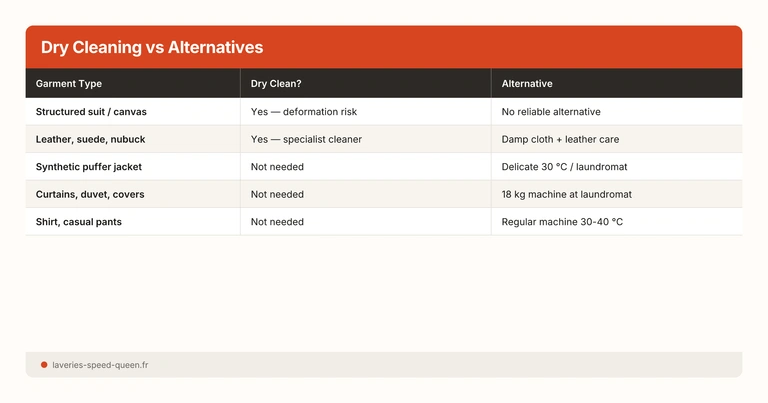
In short: dry cleaning is not “dry” in the literal sense — it is a professional cleaning process that avoids conventional water washing, often using solvents or specialised methods. It remains valuable for structured garments, certain silks, leather, and clothes at risk of deformation. However, many items that are simply bulky or delicate but water-washable fare better on a gentle cycle or at a laundromat than most people realise.
At a Glance
Circle on the care label -- refers to professional care, not a machine programme.
Structured garment -- dry cleaning is often safer than water.
Water-washable but bulky textile -- the laundromat can be a better alternative than the dry cleaner.
Home kit -- useful for refreshing, not a substitute for real dry cleaning.
Quick Answer: When Do You Really Need Dry Cleaning?
Dry cleaning is mainly useful when a garment risks losing its shape, structure, or surface finish in a conventional water wash. The real criterion is not the raw fabric alone but the construction of the piece: bonded linings, interlinings, leather, suede, sensitive silks, structured overcoats, formal suits.
Many competitors stop at “dry cleaner for delicates, machine for the rest”. That is too simplistic. In practice, many items end up at the dry cleaner not because they chemically require a solvent, but because the domestic machine is too small, too rough, or because drying at home would be impractical.
How Dry Cleaning Works
Dry cleaning is a professional process that uses solvents or specialised methods instead of a conventional water wash. Understanding how it works helps you decide when it is truly necessary.
The Process Step by Step
- Sorting and inspection: the professional examines each piece, identifies stains and fragile areas, and notes any special treatments needed.
- Pre-treatment of stains: visible stains are pre-treated with solvents or specific agents before machine cleaning. This is a crucial step that home kits cannot replicate.
- Machine cleaning: the garment is placed in a sealed machine that resembles a washing machine but uses a solvent instead of water. The solvent dissolves greasy soiling without wetting the fibres in the conventional sense.
- Extraction and drying: the solvent is recovered (recycled in a closed loop in modern facilities), and the garment is dried inside the machine or on a hanger.
- Finishing: pressing, reshaping, quality control.
It is not cleaning without liquid
The term is misleading. The garment is treated inside a machine with a liquid (the solvent), but that liquid is not water. It is a process without water, not without liquid.
Why solvents?
Organic solvents have two advantages over water: they do not cause fibres to swell (so no deformation or shrinkage), and they dissolve grease effectively without strong mechanical agitation.
Dry cleaning has evolved
The industry no longer relies solely on the historic perchloroethylene. Hydrocarbons (less toxic), silicone (D5), and wet cleaning (controlled water) also exist depending on the facility.
Solvents Used in Professional Dry Cleaning
| Solvent | Usage | Advantage | Disadvantage |
|---|---|---|---|
| Perchloroethylene (PERC) | Historic solvent, still the most widespread | Very effective on grease, fast drying | Classified as a probable carcinogen (IARC), regulated in France since 2013 |
| Hydrocarbons (KWL, DF-2000) | Main alternative to PERC | Less toxic, good environmental profile | Slower drying, slightly lower effectiveness on certain stains |
| Silicone (D5) | High-end dry cleaning | Very gentle on fibres, non-toxic | High cost, less widely available |
| Wet cleaning | Controlled water-based process | No chemical solvent, eco-friendly | Not suitable for all garments (leather, heavily structured pieces) |
Perchloroethylene is not the whole story, but it matters
Perchloroethylene was long the emblematic solvent of the dry cleaning industry. Public health sources (IARC, national environmental agencies) highlight its health and regulatory concerns, which explains the development of alternative processes. The point is not to demonise dry cleaning, but to understand when its process is justified and when a water-based solution is sufficient.
When Dry Cleaning Is Truly Necessary
Dry cleaning is not a blanket luxury. It is genuinely necessary in a limited number of cases, all linked to the structure or material of the garment.
The Circle Symbol on the Care Label
The circle on the care label indicates that the garment requires professional care. But the symbol alone is not enough to decide: you need to read all the symbols (washtub, triangle, iron, circle) together to understand what is permitted and what is not.
Cases Where Dry Cleaning Remains Essential
- Leather, suede, nubuck: these materials cannot tolerate water and require specific solvents or specialised treatment.
- Natural fur: water washing destroys the suppleness and lustre of fur.
- Structured silk (linings, formal dresses): raw silk or taffeta deforms irreversibly on contact with water. Note: some washable silks do exist — check the label.
- Interlined suits and tailored jackets: the interlinings (internal support layers) are often bonded or heat-sealed. Water can cause them to peel apart or buckle. See our guide to washing a suit.
- Garments with fragile embellishments: embroidery, beading, sequins, and glued trims can come loose or dull in a machine.
The Symbol That Changes the Decision
Before choosing dry cleaner, machine, or laundromat, read the full care label.
| Symbol | What It Means | Practical Consequence |
|---|---|---|
| Circle with letter | Professional care required | Dry cleaning or professional care remains the reference |
| Crossed-out circle | Dry cleaning prohibited | You must use water-based care only |
| Washtub present + circle absent | Water washing permitted | Domestic machine or laundromat depending on volume and delicacy |
| Crossed-out washtub + circle present | No domestic water washing | Dry cleaning is the safest route |
For the detail on P, F, W symbols and the crossed-out circle, see also the care labels guide.
When the Dry Cleaner Remains the Best Option
Dry cleaning and laundromats should not be systematically opposed. Some pieces truly belong in professional care.
Heavily structured suits
Shoulder pads, interlining, bonded linings: it is the construction, not the fibres, that causes the problem. For the detailed case, see our suit guide.
Overcoats and tailored jackets with internal support
Whenever the shape relies on internal layers, water can cause the structure to buckle or shift.
Leather, suede, hides
These materials are not suitable for conventional washing and often require a specialist, not just a standard dry cleaner.
Certain silks and formal garments
The fragility sometimes comes from the weave, the lining, or the embellishments rather than the fibre alone.
When the Machine or Laundromat Is More Than Enough
Many items go to the dry cleaner out of habit, when the real issue is volume, rinsing, or domestic drying.
| Item | Why It Often Ends Up at the Dry Cleaner by Mistake | When the Laundromat Helps |
|---|---|---|
| Synthetic duvet | Home machine too small | Large capacity + complete on-site drying |
| Washable curtains | Volume and bulkiness | Bigger drum, better agitation |
| Synthetic puffer jacket | Fear of damaging the filling | Suitable cycle + proper drying afterwards |
| Batch of cotton shirts | Confusing washing with ironing | Laundromat for the wash; dry cleaner only if you want professional per-piece ironing |
The real sorting question
Ask yourself first: does the garment truly fear water, or just a small drum, too-strong spin, or poor drying? It is this second scenario that the laundromat often solves much better than the dry cleaner, especially for bulky loads.
Cost Comparison: Dry Cleaner vs Laundromat vs Home
One of the most tangible criteria for choosing between dry cleaner, laundromat, and home washing is cost. Here is a realistic comparison based on 2026 prices.
| Item | Dry Cleaner (per item) | Laundromat (per load) | Home (per load) |
|---|---|---|---|
| 2-piece suit | EUR 12-18 | Not recommended (structured) | Not recommended |
| Overcoat / parka | EUR 15-25 | EUR 5-8 (if washable) | Approx. EUR 1 (if the machine is big enough) |
| Double duvet | EUR 20-35 | EUR 7-12 | Often impossible (capacity) |
| Puffer jacket | EUR 12-20 | EUR 5-8 | Approx. EUR 1 (risk of poor drying) |
| 5 cotton shirts | EUR 15-25 (EUR 3-5/item) | EUR 5-8 (the batch) | Approx. EUR 1 (without professional ironing) |
| Curtains (pair) | EUR 15-30 | EUR 5-8 | Often impossible (volume) |
The verdict is clear: for water-washable textiles, the laundromat is 2 to 5 times cheaper than the dry cleaner. Dry cleaning only makes financial sense for garments that genuinely need a solvent or professional finishing (suit pressing, leather treatment). For large loads, see our laundromat price comparison.
Alternatives to Dry Cleaning: Complete Guide
1. The Professional Laundromat (Best Alternative for Volume)
The Speed Queen laundromat solves the most common problem that drives people to the dry cleaner: volume. Machines from 8 to 18 kg handle duvets, curtains, puffer jackets, and large batches of laundry that a domestic machine simply cannot manage.
Key advantages:
- Capacity: 18 kg drums let you wash a double duvet or 10 kg of laundry in a single cycle.
- Complete drying: professional dryers dry in 30-45 minutes, avoiding the clumped filling problem (puffer jackets, down duvets).
- Thorough rinsing: 50-60 litres of water removes detergent residue more effectively than a domestic machine.
- Delicate cycle available: for fragile textiles that are still water-washable.
2. Hand Washing (For Delicate Items)
Hand washing remains relevant for items whose label allows water but not machine washing (washtub symbol with a hand). This includes certain washable silks, fine wools, and delicate fabrics.
Protocol:
- Cold or lukewarm water (max 30 degrees C) in a clean basin.
- Gentle liquid detergent, enzyme-free if possible.
- Soak without rubbing. Press the fabric gently into the water.
- Rinse thoroughly with clean water.
- Do not wring: roll in a towel to absorb excess moisture, then dry flat.
3. Home Dry Cleaning Kits
Home dry cleaning kits and gentle DIY methods can help in a pinch, but they replace neither a proper care label decision nor genuine professional cleaning.
Home dry cleaning kit
Typically includes a stain-removing spray and scented sheets for use in the tumble dryer. Can refresh a lightly soiled garment and reduce mild odours, but does not replicate true professional stain removal.
Advantages
Quick (20 minutes), affordable (EUR 3-5 for 4-6 uses), convenient between dry cleaner visits for refreshing a lightly worn garment.
Limitations
Does not remove set-in stains, does not deep-clean, does not treat linings or internal structures. Not a substitute for reading the care label carefully on fragile pieces.
Mistakes to Avoid
- Treating dry cleaning as mere marketing advice -- some garments genuinely deform in water.
- Thinking the dry cleaner is always better -- for many everyday washable textiles, the machine is more than enough.
- Confusing a volume problem with a textile problem -- a large laundromat machine can solve the first, not the second.
- Forgetting the garment's construction -- bonded linings and formal pieces tolerate water poorly even when the fabric seems simple.
- Using a home kit as a catch-all -- useful for refreshing, not for blindly bypassing the care label.
Where This Guide Stops
This page explains the process and the decision. For the detailed textile-by-textile breakdown, see our delicate fabrics guide. For suits, head to the suit guide. For curtains, continue with the curtains guide.
Methodology and Sources
- GINETEX / ISO 3758:2023 serves as the basis for correctly reading the circle symbol and distinguishing professional care from water washing.
- Perchloroethylene regulation references rely on public documents from Anses (French Agency for Food, Environmental and Occupational Health & Safety) and the French Ministry of the Environment regarding dry cleaning facilities.
- Competing SERP articles often explain the principle of dry cleaning but rarely detail the boundary between a genuine chemical need and a simple capacity or drying problem. This article makes that boundary actionable.
Sources and References
- GINETEX - Textile care symbols (ISO 3758:2023) (lien externe)
- Anses - Report on perchloroethylene (inhalation TRV) (lien externe)
- French circular of 16 August 2013 on dry cleaning facilities (lien externe)
- IARC (International Agency for Research on Cancer), perchloroethylene classification, consulted 23 March 2026
- Laundromat prices 2026
- Washing a suit without dry cleaning
- Delicate fabrics guide
- Washing a puffer jacket
- Washing curtains
- Washing a duvet
- Care labels guide
As an Amazon Associate, we earn a small commission on purchases made through the affiliate links in this article — at no extra cost to you. This helps us maintain this site and produce free guides.
Dry cleaning has its place for certain sensitive garments, but many washable textiles are expensive at the dry cleaner mostly because of volume or ironing, not because they require a solvent. For a case-by-case comparison, continue with the delicate fabrics guide , then check our prices if the laundromat is the right option.