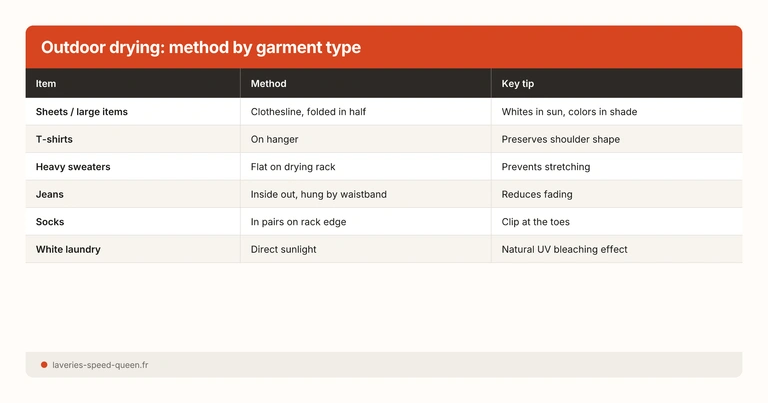
In short: drying laundry outdoors is free, eco-friendly and effective — as long as you follow a few rules. Wind matters more than sunlight for evaporation. Darks go in the shade, whites in the sun. Each garment type has its own hanging method (clothesline, hanger, flat). White vinegar in the rinse cycle fixes stiffness. And when conditions are not right, a professional dryer at the laundromat takes over in 20-30 minutes.
At a Glance
Wind is more effective than sunlight -- a windy, overcast day often dries faster than a hot, calm one.
Darks in the shade, whites in the sun -- UV fades dark fabrics but bleaches whites naturally.
Shake before hanging -- reduces stiffness and speeds up drying.
White vinegar in the rinse -- neutralises limescale that makes laundry stiff.
The Benefits of Outdoor Drying
Outdoor drying is the oldest, cheapest and most eco-friendly method. Here are its real advantages — without exaggeration.
Free and Zero Energy Consumption
A tumble dryer uses an average of 2 to 4 kWh per cycle, roughly 0.50 to 1 EUR per load. Over a year with 200 cycles, outdoor drying saves 100 to 200 EUR in electricity. It is the easiest energy cost to eliminate. For more on laundry energy use, see our article on saving energy on laundry.
Natural Bleaching and Disinfecting from UV
Sunlight exerts a natural bleaching effect on white laundry. UV rays break down the organic compounds responsible for yellowing and reduce surface bacteria. It is not as powerful as a 60 degrees C wash, but it is a useful complement, especially for white sheets and towels. Our article on whitening yellowed laundry covers other methods.
No Shrinking or Felting
The tumble dryer is the number-one cause of clothing shrinkage. Heat combined with the mechanical tumbling of the drum contracts fibres, especially in cotton and wool. Air drying preserves the dimensions and structure of the fabric. See our shrinkage prevention guide for the most sensitive textiles.
No Microplastics in the Air
Tumble dryers release synthetic microfibres into the air through their vents. Outdoor drying eliminates this problem. Our article on microplastics and laundry explains the phenomenon in detail.
The Real Environmental Balance
Outdoor drying is objectively the most eco-friendly method: zero energy, zero microplastics released indoors, better textile preservation. Its only drawback is weather dependence — and that is a real limitation, not a minor detail.
Ideal Conditions for Outdoor Drying
Wind: The Number-One Factor
Water evaporation depends mainly on air renewal around the fabric. Wind carries away the moisture-saturated air surrounding the laundry and replaces it with dry air, speeding up evaporation. A windy, overcast day often dries faster than a hot, windless one.
Ideal wind: moderate (15-25 km/h). Too strong and items blow off the line or airer. Too weak (under 10 km/h) and drying time increases significantly.
Sunlight: Helpful but Not Essential
Sunlight helps drying in two ways: heat speeds evaporation, and UV bleaches white laundry. But direct sunlight also has downsides (colour fading, fibre wear).
Ideal position: partial shade or filtered sunlight for colours, full sun for whites only.
Humidity: The Forgotten Factor
The ambient air must be able to absorb moisture from the laundry. If relative humidity exceeds 70-80%, drying is very slow or even impossible. This is why:
- Dry, windy days are ideal, even when cool.
- Hot, humid days (before a storm) are the worst for outdoor drying.
- In winter, cold air is often very dry — drying works despite the low temperatures.
Hanging Method by Garment Type
Each garment has an optimal method for drying quickly, keeping its shape and avoiding creases.
Sheets and Large Items
Clothesline at height
Fold the sheet in half lengthwise and hang it over the line. The weight of the water smooths the fabric naturally. Let both sides hang unevenly so the wind circulates between the layers.
On an airer
If you only have an airer, drape the sheet in a zigzag over several parallel bars. Avoid folding it onto itself on a single bar -- fabric touching fabric blocks evaporation.
T-Shirts and Shirts
Hang them on a hanger to preserve the shoulder shape. Button the top and bottom buttons on shirts to prevent wind creases. If using an airer, hang inside out to protect the visible side from sun fade.
Never peg a t-shirt by the shoulders with a clothes peg — the weight of the wet fabric stretches the garment and leaves permanent peg marks. Peg on the side seams or use a hanger.
Jumpers and Heavy Knits
Dry flat on a mesh drying rack or a clean towel laid over the airer. Wet jumpers are heavy — hung up, they stretch lengthwise and lose their shoulder shape. Flat drying is non-negotiable for wool, cashmere and thick knits. See our guide on washing wool jumpers for the full protocol.
Jeans and Trousers
Hang them inside out, suspended by the waist with two pegs on the belt loops. The opening pointing downward lets air circulate inside. Jeans are the slowest outdoor-drying garments — their thick weave retains a lot of water. See our jeans washing guide.
Underwear and Socks
Hang socks in pairs on the edge of the airer. Underwear clips by the waistband elastic. Avoid hanging them in full sun if you live in a flat — it is often a source of friction with neighbours, regardless of the building rules.
Towels
Hang them fully spread out, without folding. A towel folded in half dries twice as slowly. Shake it vigorously before hanging to open up the fibres — this is the single most effective step against stiffness. See our guide on keeping towels fluffy for more tips.
Mistakes to Avoid
- Direct sunlight on dark colours -- UV gradually fades black, navy and red. Hang darks inside out or in the shade.
- Drying during pollen peaks -- damp laundry captures pollen like a trap. Particularly problematic for allergy sufferers in spring.
- Pegging t-shirt shoulders -- the weight of wet fabric stretches the garment and leaves permanent peg marks.
- Leaving laundry out overnight -- dew re-dampens the fabric. Insects and bird droppings are also a risk.
- Overloading the airer -- items touching each other will not dry. Space each piece at least 5 cm apart.
- Forgetting to shake before hanging -- without shaking, laundry dries creased and stiff.
Pollen: A Real Problem in Spring
From March to June, pollen concentrations are high. Damp laundry outdoors acts as a natural collector — pollen grains stick to wet fibres. For allergy sufferers, this is a direct trigger for rhinitis, sneezing and eye irritation.
Solutions:
- Check the pollen forecast for your area before hanging laundry.
- Prefer low-concentration hours: early morning (before 8 am) or late evening (after 7 pm).
- During peaks, use a tumble dryer (at the laundromat if you do not have one at home).
Bird Droppings
Freshly washed laundry stained by a bird is frustrating. Areas under power lines, aerials and trees are most exposed. Avoid these spots. If it happens, rinse immediately with cold water (dried droppings are much harder to remove).
The Stiffness Problem
Outdoor-dried laundry is often stiffer than laundry from a tumble dryer. Three factors explain this.
Limescale
Tap water contains limescale (calcium carbonate). During drying, the water evaporates but the limescale remains in the fibres and crystallises, making the fabric rigid. The harder the water, the stiffer the laundry.
Solution: add half a glass of white vinegar↗ to the fabric softener compartment. Vinegar neutralises limescale without leaving any odour after drying. See our guide on white vinegar and laundry for uses and limits.
No Mechanical Action
In a tumble dryer, the drum tumbles and softens fibres by rubbing them together. Outdoors, wind partially plays this role, but not as effectively. The result: fibres dry in a rigid position.
Solution: shake each item vigorously before hanging AND after drying, before folding. This double shake makes a real difference.
Over-Drying
Laundry left in the sun too long loses all residual moisture and becomes brittle. Fabric needs to retain a very slight dampness to stay supple.
Solution: bring the laundry in as soon as it feels dry to the touch — not two hours later.
White Vinegar: The Simplest Solution
Half a glass of white vinegar in the fabric softener compartment with every wash solves 80% of the stiffness problem. It costs less than 0.10 EUR per cycle, it is eco-friendly and compatible with all textiles. It replaces commercial fabric softener with better results, especially for towels, which become less absorbent with softener.
Clothes Pegs: Wood or Plastic?
The choice of peg seems trivial, but it affects the lifespan of your clothes and your pegs.
Wooden Pegs
- Pros: leave fewer marks on fabric (softer surface), adequate grip, biodegradable.
- Cons: warp and blacken over time if left outdoors; the metal spring rusts.
- Care: bring them in after use. Wooden pegs left permanently on the line last 6 months. Stored indoors, they last years.
Plastic Pegs
- Pros: weather-resistant, rust-free, inexpensive.
- Cons: plastic becomes brittle in sunlight (UV) and snaps after 1-2 years of permanent exposure. The metal spring can leave rust marks on laundry.
- Care: as with wood, bring them in to double their lifespan.
How to Peg Without Marking
- Clip on seams, hems or hidden areas.
- For shirts: clip on the side seams under the arms, or use a hanger.
- For trousers: clip on the belt loops.
- For sheets: clip on the corners, where the fabric is doubled.
Balcony Drying: Rules and Good Neighbourliness
What the Law Says
In most countries, there is no blanket ban on drying laundry on a balcony. However, building or homeowner association rules may restrict or prohibit it. Common restrictions include:
- Laundry visible from the street (front facade).
- Lines strung between buildings.
- Laundry hanging over the balcony railing.
What is generally tolerated: a freestanding airer on the balcony, below railing height, not visible from the street.
Good Practices in Shared Buildings
- Check your building rules before setting up a visible airer.
- Prefer a foldable standing airer rather than a fixed line.
- Avoid drying laundry on the main facade of the building.
- Laundry that drips onto the balcony below is a frequent source of conflict — spin sufficiently before hanging.
Outdoor Drying in Winter
Outdoor drying in winter is possible thanks to a physical phenomenon: sublimation. Below 0 degrees C, the water in the laundry freezes and then passes directly from solid to gas (without passing through the liquid state). The process is slow but effective if the air is dry.
Conditions needed:
- Dry air (low relative humidity — common in winter during cold, sunny weather)
- Wind, even light
- No precipitation
Limitations: winter drying takes 24 to 48 hours depending on conditions, versus 2 to 4 hours in summer. Thick items (jeans, towels) may need finishing indoors. It is a complementary solution, not a full replacement for summer drying.
When Outdoor Drying Is Not Enough
Certain situations make outdoor drying impractical or insufficient:
Prolonged Bad Weather
Several consecutive rainy days, persistently high humidity. The laundry either does not dry or dries too slowly, encouraging bacteria and odours.
No Balcony or Garden
In a flat without outdoor space, indoor drying becomes the only option -- with the risks of humidity and mould documented in our article on indoor drying.
Pollen Season
For allergy sufferers, outdoor drying in spring is inadvisable. The laundry captures pollen and brings it straight into your bedding and clothes.
Large Volumes or Urgency
Duvets, the whole family's sheets, return from holiday -- sometimes you need to dry 15-20 kg of laundry fast. A clothesline is not built for that.
In these situations, a professional tumble dryer at the laundromat is the most effective solution. A commercial dryer fully dries a load in 20 to 30 minutes, versus 2 to 8 hours outdoors. It is the fallback when the weather, available space or laundry volume exceeds the capacity of an airer.
See our complete drying guide for choosing the right method for each situation, and our article on indoor drying and humidity if you regularly dry indoors.
Outdoor Drying and the Environment: The Balance
Outdoor drying is the most eco-friendly method there is:
- Zero energy consumption: no electricity, no gas.
- Zero airborne microplastics: unlike a tumble dryer, which vents synthetic microfibres.
- Better textile preservation: no shrinkage, no heat damage, no felting.
- Longer garment lifespan: an air-dried garment lasts longer than one regularly tumble-dried.
For more on the environmental aspects of laundry, see our article on microplastics and laundry and our piece on fast fashion and laundry impact.
As an Amazon Associate, we earn a small commission on purchases made through the affiliate links in this article — at no extra cost to you. This helps us maintain this site and produce free guides.
When the weather is not cooperating or the volume of laundry exceeds your airer’s capacity, our laundromats in Blagnac , Croix-Daurade and Montaudran have professional dryers that fully dry a load in 20-30 minutes — the ideal backup when outdoor drying is not an option. Payment contactless card or cash.
Sources and References
- ADEME, Guide pratique : reduire sa facture d’electricite, 2024
- International Journal of Environmental Research and Public Health, UV exposure and textile degradation, 2022
- RNSA — Pollen bulletins (lien externe)
- Complete drying guide
- Indoor drying and humidity
- Tumble dryer forbidden symbol
- Energy-saving laundry guide
- Microplastics and laundry